
There is something strange about being a journalist in a small town.
You can spend the morning chasing a story about millions of rands in municipal expenditure and, an hour later, find yourself standing next to a braai while somebody explains why Barrydale’s worst coffee is actually the best one in town.
You can be following a corruption investigation one day and writing about a local musician, a boxing match or somebody’s extraordinary vegetable garden the next.
And sometimes the biggest story is simply a person.
That has been the journey of News62 for the past six years.
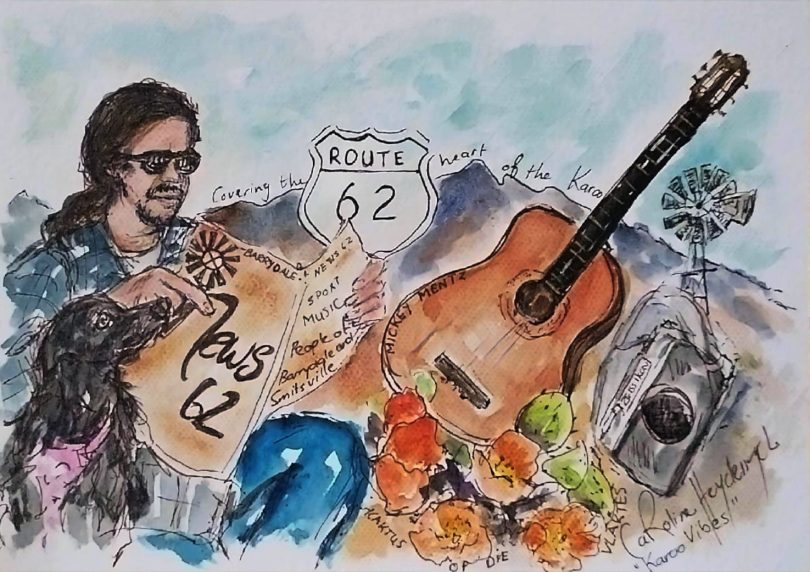
It started with a fairly simple idea: tell the stories of the people and places along Route 62.
But somewhere along the way, the definition of “news” became considerably wider.
Because a town is not just its politicians, crime statistics and municipal accounts.
A town is the woman who rebuilt her life after addiction.
It is the man who quietly helps a stranded family and never asks for recognition.
It is the pensioner who knows every building in the village.
It is the boxer who trains in a small-town gym because he believes he can become something bigger.
It is the business owner who nearly loses everything during Covid and somehow starts again.
It is the person who dies suddenly and leaves an entire village wondering how the place will ever feel quite the same again.
And yes, sometimes it is also a municipal report that costs hundreds of thousands of rand and raises more questions than answers.
Over six years, News62 has reported on all of it.
Looking back through the archive, these are twelve stories that, for very different reasons, still stand out.
THE HIGHS
1. From a small Karoo weavery to Paris Fashion Week
There are stories where you know, almost immediately, that you are watching something special.
The Barrydale Hand Weavers’ journey is one of them.
What makes the story particularly satisfying is that it was never really about fashion.
It was about people.
A small rural business employing and supporting more than 30 families had quietly been producing beautiful, environmentally conscious textiles in Barrydale.
Then came Paris.
Their work became part of a Uni Form collection showcased at Paris Fashion Week, putting the work of Barrydale’s weavers in front of an international audience.
For a village journalist, it was one of those moments when the world suddenly becomes very small.
Something being made by hand in Barrydale had found its way onto one of the world’s biggest fashion stages.
And News62 had been there to tell the story before the champagne corks popped in Paris.
2. The people who make Barrydale, Barrydale
Some of the stories that have given News62 its character were never particularly “important” in the traditional news sense.
And that is precisely why they matter.
Over the years the publication has followed characters like Meyer Joubert, Barrydale’s unofficial “Mayor”, whose story was less about farming or wine and more about a simple act of kindness towards strangers who found themselves in trouble.
There were the stories about Doris Daydream Nadler and her determination to preserve Barrydale’s heritage.
There were musicians, artists, bikers, market traders, chefs, eccentric locals and people who simply decided to do something interesting with their lives.
These stories may not make national headlines.
But put them together and they become something more valuable.
A record of a place and the people who gave it its personality.
3. A woman who escaped the life she thought she wanted
One of the earliest News62 stories that still stands out is the story of Elizabeth Beer.
Before Barrydale, she had lived a very different life.
Designer shoes. Flashy cars. Celebrity events. The glamorous world of high-end event management.
Then came addiction.
Eventually she traded the city for Barrydale and began rebuilding her life through yoga and a radically different way of living.
It was exactly the kind of story that suited the early News62 approach.
There was no political angle.
No scandal.
No government statement.
Just a human being who had been somewhere dark and found a way back.
Those stories matter because they remind readers that somebody’s past does not necessarily have to dictate their future.
4. Barrydale’s fighters
Six years ago, News62 was already telling stories about people trying to build something with very little.
One of those stories followed the young boxers of Barrydale’s Panic Room Boxing Club, now Barrydale Fight Club.
What began as a group of friends having fun developed into serious training, competition and fundraising.
Then former South African bantamweight champion Theo Modise arrived to put the fighters through their paces.
There was something wonderfully local about the story.
A small-town boxing club. A group of young fighters. A former champion giving them his time. And a community trying to raise money to help them get to provincial championships.
That is the sort of story News62 was created to tell.
5. R30, one hour of care
Sometimes the best community stories are the simplest.
Barrydale Hand Weavers launched a fundraising campaign allowing customers to contribute towards Barrydale Hospice by effectively buying hours of care.
The amount started at just R30.
Eventually, the campaign raised R18,000.
But the money was only part of the story.
The real story was the connection between two very different local institutions: the people creating beautiful things with their hands and the people caring for residents during some of the most difficult moments of their lives.
When the Hospice team visited the Weavers, the story became even more human.
They swapped stories.
They tried their hands at weaving.
They laughed.
For a moment, two very different forms of community care became one.
6. When a little village decided to put itself on the map
One of the things that has always made Barrydale interesting is that people here rarely wait for somebody else to make something happen.
Over the years, News62 has followed countless examples of that spirit: community projects, festivals, fundraisers, artists, musicians, small businesses and ordinary residents who simply decide that something needs to be done.
One story that captures this particularly well is Barrydale in Bloom.
What could easily have been just another small-town gardening initiative became something much bigger: residents taking pride in their streets, their gardens and the appearance of their village, while creating something that brought people together.
It is easy to underestimate stories like these. There is no scandal. No multimillion-rand tender. No police tape. Just people caring about where they live.
And perhaps that is one of the greatest highs of the past six years.
Because News62 was never created only to expose what is wrong.
It was also created to show what is right.
THE LOWS
The lows are different.
These are not stories that were badly reported or stories News62 wishes it had not covered.
They are the stories that stayed with you because there was no happy ending, because somebody was grieving, because people were angry, or because the questions remained long after the article had been published.
1. Bella
Some stories are impossible to separate from the people telling them.
Bella was one of those.
The death of my four-year-old spaniel after she allegedly consumed poison became the catalyst for a much wider conversation about the use of toxic substances in Barrydale.
What began with the death of one dog developed into protests, allegations, investigations and growing concern about the effect of poison on animals, birds and the wider ecosystem.
But underneath all of that was a dog.
A beloved family member.
And a grieving owner who decided that Bella’s death should mean something more.
It became one of the most emotionally charged stories News62 has ever carried.
2. Shane Petzer’s sudden death
On 6 October, 2021, Barrydale woke to news that Shane Petzer had died unexpectedly.
The shock was made even more difficult by the fact that Shane had been out in the village just hours earlier.
He had been visiting friends. He had been promoting Barrydale in Bloom.
He had been doing what Shane did: moving around, talking to people and involving himself in the life of the village.
Then he was gone. The story was not really about how he died.
It was about what happens to a small community when one of its characters disappears overnight.
The subsequent tributes made one thing clear. Shane had left fingerprints all over Barrydale.
3. Covid and the people who almost lost everything
During Covid, some of the hardest stories were not about infection numbers.
They were about survival.
One of those was the story of Sarah Fitz-Gerald and the Donkey Shed.
The lockdown brought her restaurant business almost to its knees. She had paid her staff and was left with very little.
There were days when she admitted that getting out of bed felt almost impossible, but the crisis forced her to reinvent the business.
The Donkey Shed, today Papa Joe’s Collectables, became something different, selling previously loved items and finding another way to survive.
It was a reminder that behind every shuttered restaurant or empty tourism business was a person wondering whether they would make it through.
4. The 13-year-old boy in Matjoks
There are stories where the journalist has very little to add.
The death of a 13-year-old boy in Matjoks after he was found stabbed was one of them.
It was a devastating story for the community and, as with any story involving a child, one where facts, restraint and sensitivity matter more than dramatic language.
No headline can adequately describe what the family lost.
And no article can fix it.
Sometimes journalism’s only job is to make sure that a tragedy is not reduced to a number.
5. The families behind the headlines
Over the years, News62 has had to report on deaths, serious accidents, crime and violence in communities where everybody knows somebody involved.
That creates a particular challenge for a small publication.
The person in the photograph might be your neighbour. The victim might have gone to school with somebody you know. The accused might be somebody whose family shops at the same store as you.
There is no comfortable distance. That has probably been one of the hardest parts of six years of hyperlocal reporting.
The stories are close. Sometimes uncomfortably close and yet they still need to be told.
6. When asking questions makes you part of the story
The most difficult stories have increasingly involved accountability.
The Swellendam roadblock investigation is perhaps the clearest example.
What began after members of the public approached News62 with concerns about the way they had been treated at roadblocks developed into sustained reporting, municipal responses, a forensic investigation and continuing questions about what happened afterwards.
The municipality disputed aspects of News62’s reporting. News62 kept asking questions.
A Mubesko forensic investigation was eventually commissioned. The report was completed and tabled before Council.
And now the question has changed.
It is no longer simply: What happened?
It is:
What was done about it?
That distinction is important.
News62 has increasingly found itself reporting not only on what investigations uncover, but on what happens after the reports land on politicians’ desks.
And that can be an uncomfortable place for a small publication to operate.
But local journalism that only reports what powerful people are comfortable saying is not much use to anybody.
SIX YEARS. ONE VERY BIG LITTLE STORY.
When you look at the archive as a whole, something becomes apparent.
News62 was never really just about news.
It was about people.
The people who build businesses from nothing.
The people who keep community organisations alive.
The people who make music.
The people who rescue animals.
The people who coach children.
The people who fight addiction.
The people who quietly help strangers.
The people who lose loved ones.
The people who stand up when something doesn’t seem right.
And, occasionally, the people who find themselves on the other side of a News62 investigation.
That is probably why the publication has survived.
Because in a world where everyone is shouting for attention, local journalism still has one enormous advantage:
we know the people we write about.
We see them at the supermarket.
At the petrol station.
At the pub.
At the school.
At the braai.
At Council.
And sometimes, unfortunately, at funerals.
Six years ago, News62 started with a very simple idea of telling the stories of the R62.
Six years later, the R62 has told us a few stories right back.
And then there are the people who made it possible
None of this happens without the businesses that continue to put their money behind local journalism.
Every advert that has appeared on News62 has helped keep the lights on, the stories moving and the newsroom independent.
To every advertiser who has supported us (me) over the past six years, whether you have been with us from the beginning or joined us recently: thank you.
You did not simply buy advertising space.
You helped create a platform for the communities in which you live and work.
You helped me tell the stories of your customers, your neighbours, your employees and sometimes your friends.
And in a small community, that matters.
So here’s to six years of News62.
To the good stories.
The difficult ones.
The ridiculous ones.
The heartbreaking ones.
The stories that made us laugh.
The stories that made us angry.
And the stories that made us stop for a moment and remember why local journalism still matters.
There are plenty more stories to tell.
And, judging by the past six years, plenty more people worth telling them about.
Cover Photo: Caroline Heydenrych